If you have been running email marketing for any length of time, you know the drill. Build a list, write a sequence of emails, set the timing, hit send. Everyone gets the same emails in the same order at the same intervals. It works, sort of. Open rates sit around 20%, click rates around 2-3%, and you accept those numbers because that is just how email marketing goes.
AI lead nurturing takes a fundamentally different approach. Instead of sending the same sequence to everyone, it watches how each individual behaves and adapts the conversation accordingly. The difference in results is significant enough that every SMB owner should understand what is changing and why it matters.
How Traditional Email Marketing Works
Let us start with the baseline so the comparison is clear.
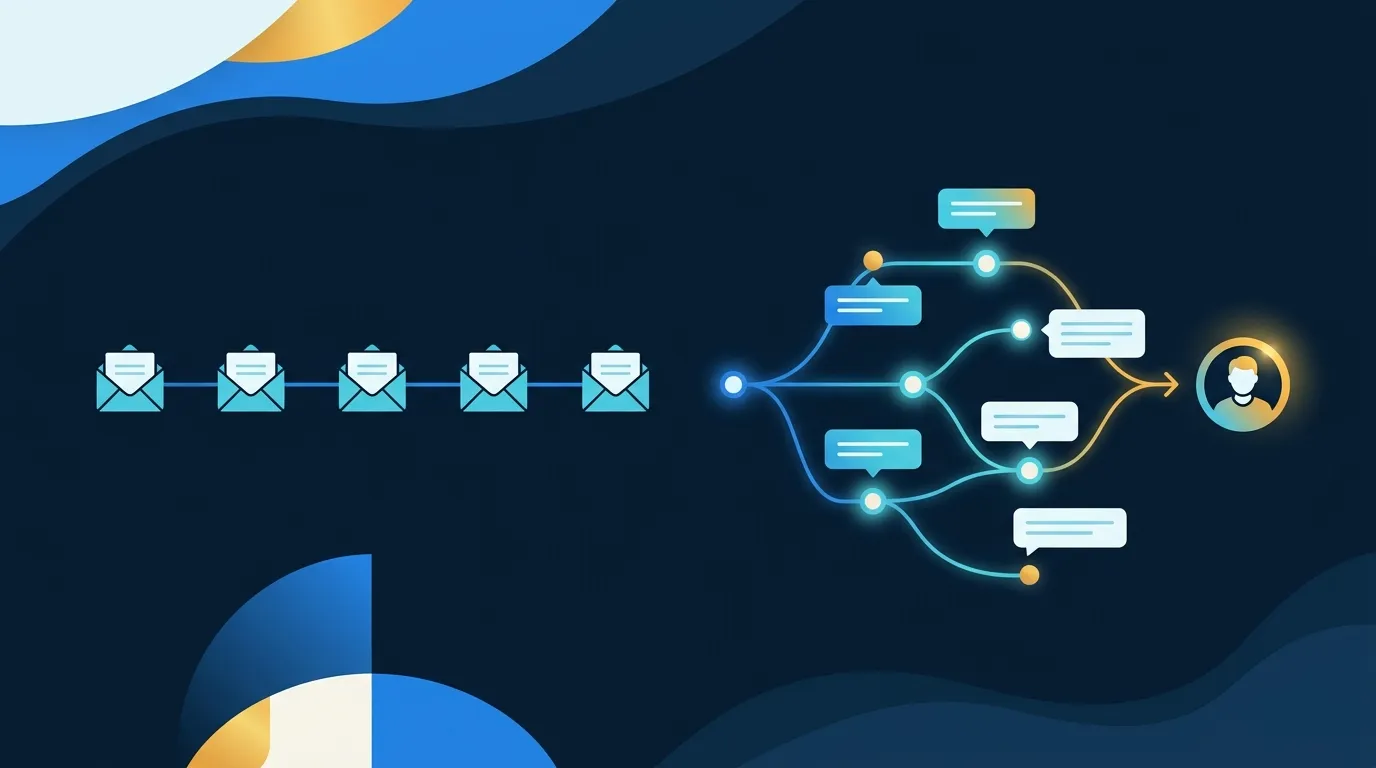
Traditional email marketing (often called drip campaigns or autoresponders) follows a linear path:
- Someone joins your list (downloads a guide, fills out a form, makes an enquiry)
- They receive Email 1 on Day 0
- They receive Email 2 on Day 3
- They receive Email 3 on Day 7
- And so on, regardless of whether they opened any of the previous emails
The sequence is pre-written, the timing is fixed, and everyone receives the same content. You might segment your list into a few groups (new leads vs. existing customers, for example), but within each segment, the experience is identical.
This approach has been the standard for over a decade, and it still delivers positive ROI for most businesses. But it has some fundamental limitations that become obvious once you compare it to what AI makes possible.
How AI Lead Nurturing Works
AI-powered nurture sequences start with the same trigger, someone enters your system, but everything after that adapts based on behaviour.
Here is what that looks like in practice:
Scenario 1: The engaged prospect. Sarah downloads your pricing guide on Monday. She opens the first email within an hour, clicks through to your services page, and spends four minutes reading about your premium package. The AI recognises this as high-intent behaviour and sends her a personalised follow-up on Tuesday, not a generic “just checking in” email, but a message specifically about the premium package she was reading about, with a direct link to book a consultation.
Scenario 2: The slow burner. James downloads the same pricing guide. He does not open the first email for three days. When he does, he skims it quickly and does not click anything. The AI adjusts: instead of pushing for a meeting, it sends him an educational piece about common mistakes businesses make when choosing a service like yours. It gives him space to learn at his own pace, gradually building trust rather than pushing for a conversion he is not ready for.
Scenario 3: The comparison shopper. Lisa opens every email immediately but never clicks. She visits your website twice a week, spending time on your case studies page. The AI identifies this pattern, she is interested but comparing options. It sends her a comparison guide and a client testimonial from a business similar to hers, directly addressing the decision-making process she is in.
Same starting point. Three completely different nurture paths. None of them required you to manually decide what to send or when.
The Key Differences That Matter
Timing
Traditional: Emails go out on a fixed schedule. Day 0, Day 3, Day 7, Day 14. If a lead is ready to buy on Day 1, they still get the Day 3 email about “getting started.” If they are not ready until Day 30, the sequence has already ended and they have gone cold.
AI: Messages are triggered by behaviour, not arbitrary time intervals. A highly engaged lead might receive three touchpoints in two days. A slow burner might receive one touchpoint per week for six weeks. The AI matches the pace of communication to the pace of the prospect’s interest.
Content Selection
Traditional: Everyone gets the same emails. You might write three or four versions for A/B testing, but the winning variant goes to everyone regardless of individual preference.
AI: Content is selected based on what each individual has engaged with. If someone clicked on a case study about a dental practice, the next touchpoint references dental practices. If someone spent time on your pricing page, the next message addresses value and ROI. The system learns what resonates with each person and adjusts accordingly.
Channel
Traditional: Email only (sometimes with SMS bolted on as an afterthought, sending the same message via a different channel).
AI: Multi-channel by design. The system chooses the channel based on where the individual is most responsive. If someone never opens emails but reads every SMS, the AI shifts to SMS. If they engage most on your website chat, it prioritises chat-based touchpoints. Some platforms even coordinate across email, SMS, chat, and retargeting ads.
Response to Inaction
Traditional: If someone stops engaging, the drip campaign keeps sending emails on schedule until the sequence ends. Then nothing. The lead sits in your database until you manually run a re-engagement campaign months later.
AI: Inaction is a signal. If someone stops engaging, the AI adjusts, it might reduce frequency, change the content type, try a different channel, or trigger a “we noticed you have gone quiet” re-engagement message. It can also score leads down and alert you that a previously hot prospect has cooled, so you know where to focus your personal follow-up.
Measurement
Traditional: You measure open rates, click rates, and conversion rates for the overall campaign. You know how the sequence performs on average but have limited visibility into individual journeys.
AI: You get individual-level engagement scoring. You can see exactly where each lead is in their buying journey, what content they have consumed, how their engagement is trending, and what action the AI plans to take next. This gives you and your sales process much better intelligence about who to focus on.
What This Means for Different Business Types
Service Businesses (Trades, Allied Health, Professional Services)
For most Australian service businesses, the sales cycle is short, someone has a problem, they look for a solution, and they hire someone within days. Traditional drip campaigns often miss this window because they are paced too slowly.
AI nurturing detects urgency signals (visiting your “emergency services” page, searching for same-day availability, opening multiple emails in quick succession) and accelerates the follow-up. For a plumber, this might mean the difference between reaching a hot lead within the hour versus sending them a generic email three days later.
Ecommerce
Abandoned cart recovery is the most obvious application. Traditional systems send the same “you left something in your cart” email to everyone. AI systems can differentiate between a price-sensitive shopper (send a discount code), an indecisive browser (send social proof and reviews), and a distracted buyer (send a simple reminder). Each approach converts better when matched to the right person.
Beyond cart recovery, AI nurturing can personalise product recommendations, post-purchase follow-up sequences, and win-back campaigns based on individual purchase history and browsing behaviour.
B2B and High-Value Services
Longer sales cycles benefit enormously from AI nurturing. A consulting firm with a six-month sales cycle cannot afford to run a five-email drip and then go silent. AI nurturing maintains contact across the entire decision-making period, adjusting the cadence and content as the prospect moves through their internal approval process.
Common Objections Addressed
“This sounds expensive.” AI lead nurturing platforms for SMBs typically cost $100-$400 per month, more than a basic email tool ($20-$50/month) but far less than the revenue recovered from better conversion rates. If the platform converts even one extra lead per month, it has paid for itself.
“I do not have enough leads to justify this.” AI nurturing actually matters more when lead volume is low. If you only get 30 leads per month, you cannot afford to lose any of them to a poorly timed generic email. Every lead gets the best possible experience, maximising your conversion rate from a smaller pool.
“My current email marketing works fine.” It probably does generate some return. The question is whether it could generate more. Businesses that switch from traditional drip campaigns to AI-powered nurturing typically see conversion rate improvements of 20-50%. On the same lead volume, that is a meaningful revenue increase.
“I do not have time to set this up.” The initial setup takes longer than a basic drip campaign, you need to provide more business context and define your ideal outcomes. But once it is running, AI nurturing requires less ongoing management than traditional campaigns. The system optimises itself based on results, rather than requiring you to manually test and adjust.
Making the Transition
You do not need to abandon your existing email marketing overnight. A practical transition looks like this:
- Keep your current system running while you evaluate AI nurturing platforms
- Start with one segment: new leads are usually the best place to begin, because the impact of fast, personalised follow-up is most dramatic there
- Run both systems in parallel for a month and compare conversion rates
- Expand the AI system to cover more segments as you prove the ROI
- Phase out static drip campaigns as the AI system proves itself
The technology is mature enough that this is no longer an early-adopter experiment. It is a competitive necessity for businesses that want to convert leads at the highest possible rate.
Brightwater Digital builds AI-powered lead nurturing systems for Australian businesses. We set up the platform, configure the intelligence, and integrate it with your existing CRM and tools. Explore our lead nurturing service or book a free strategy session to see how AI nurturing would work for your business.